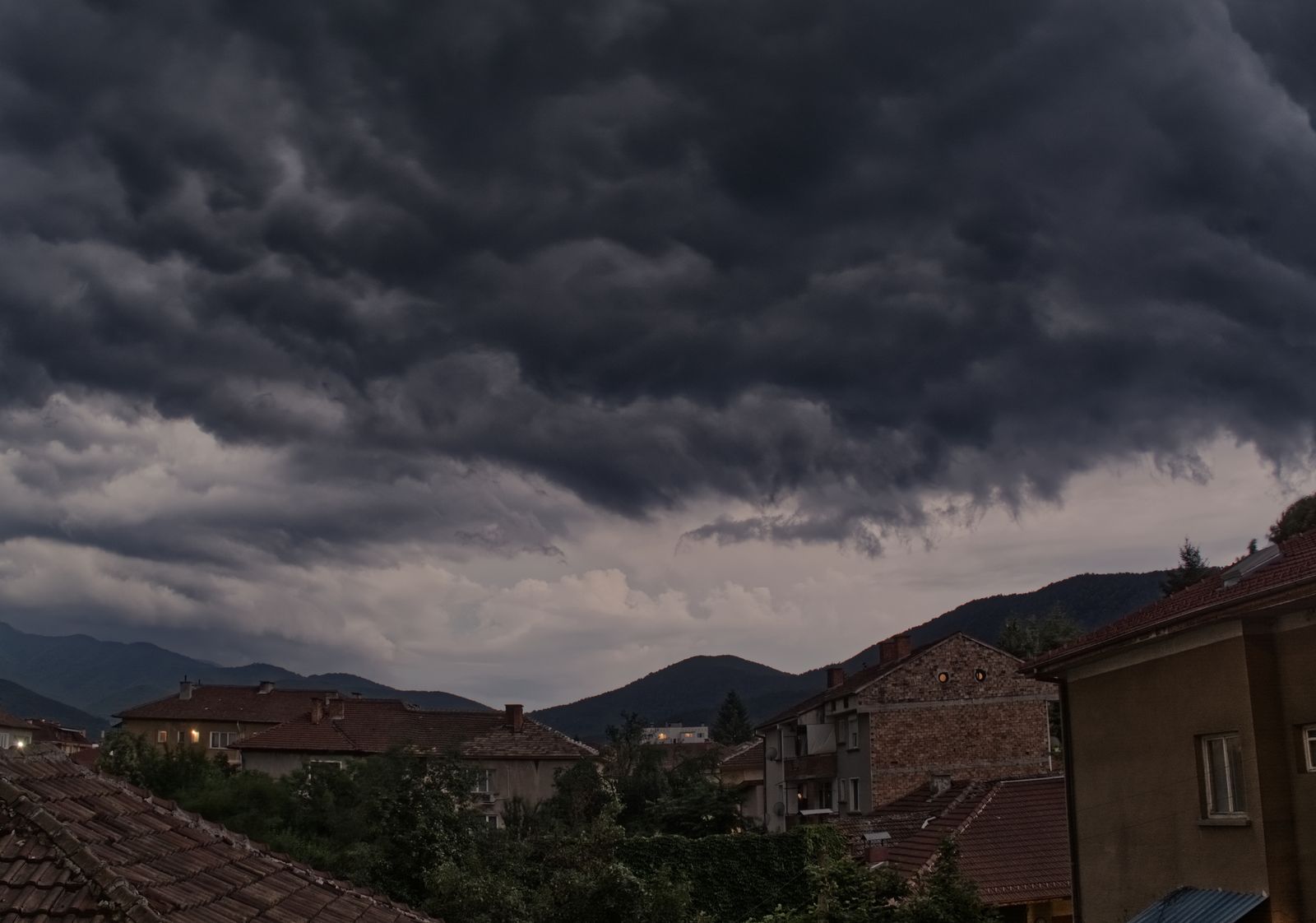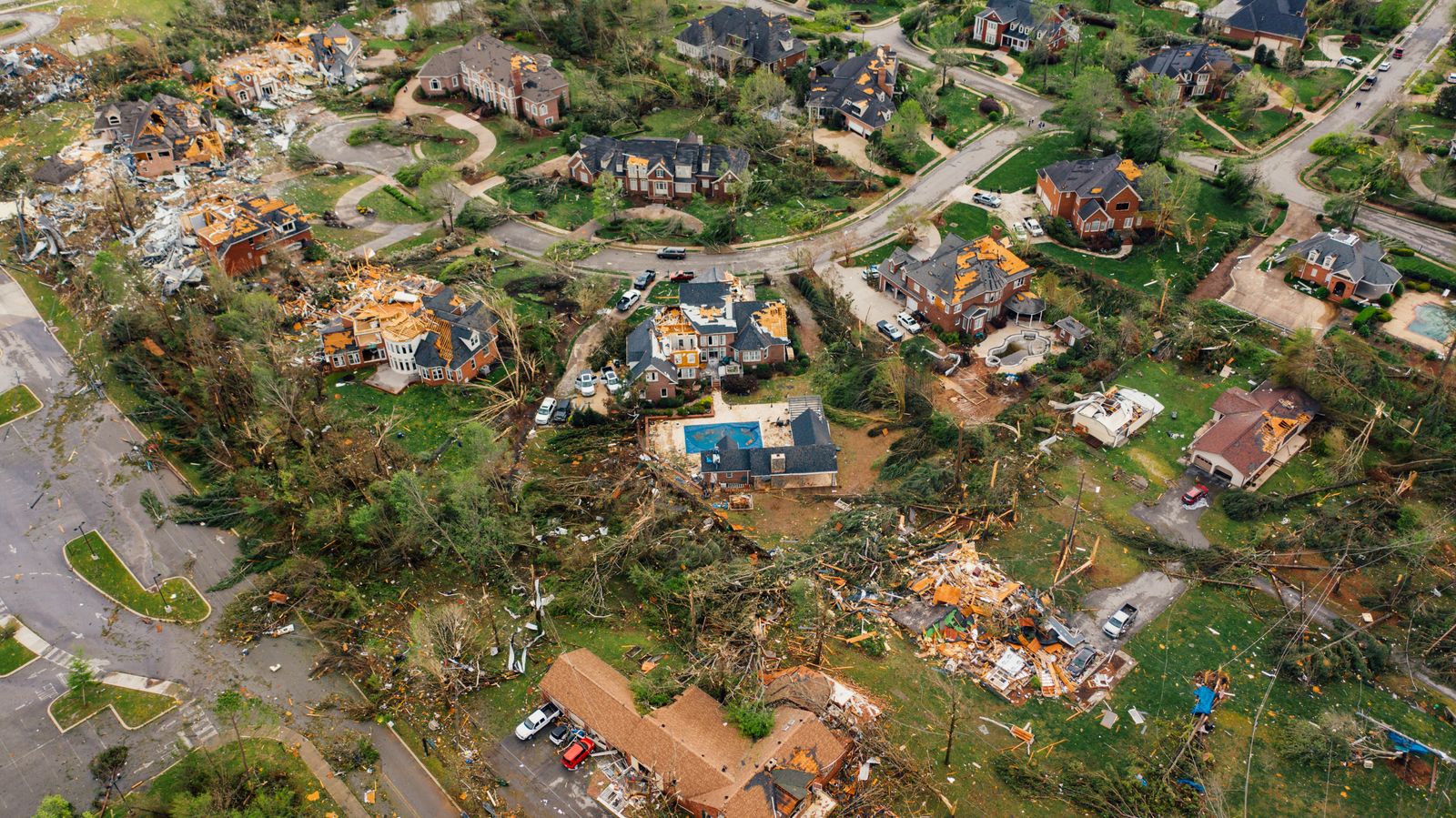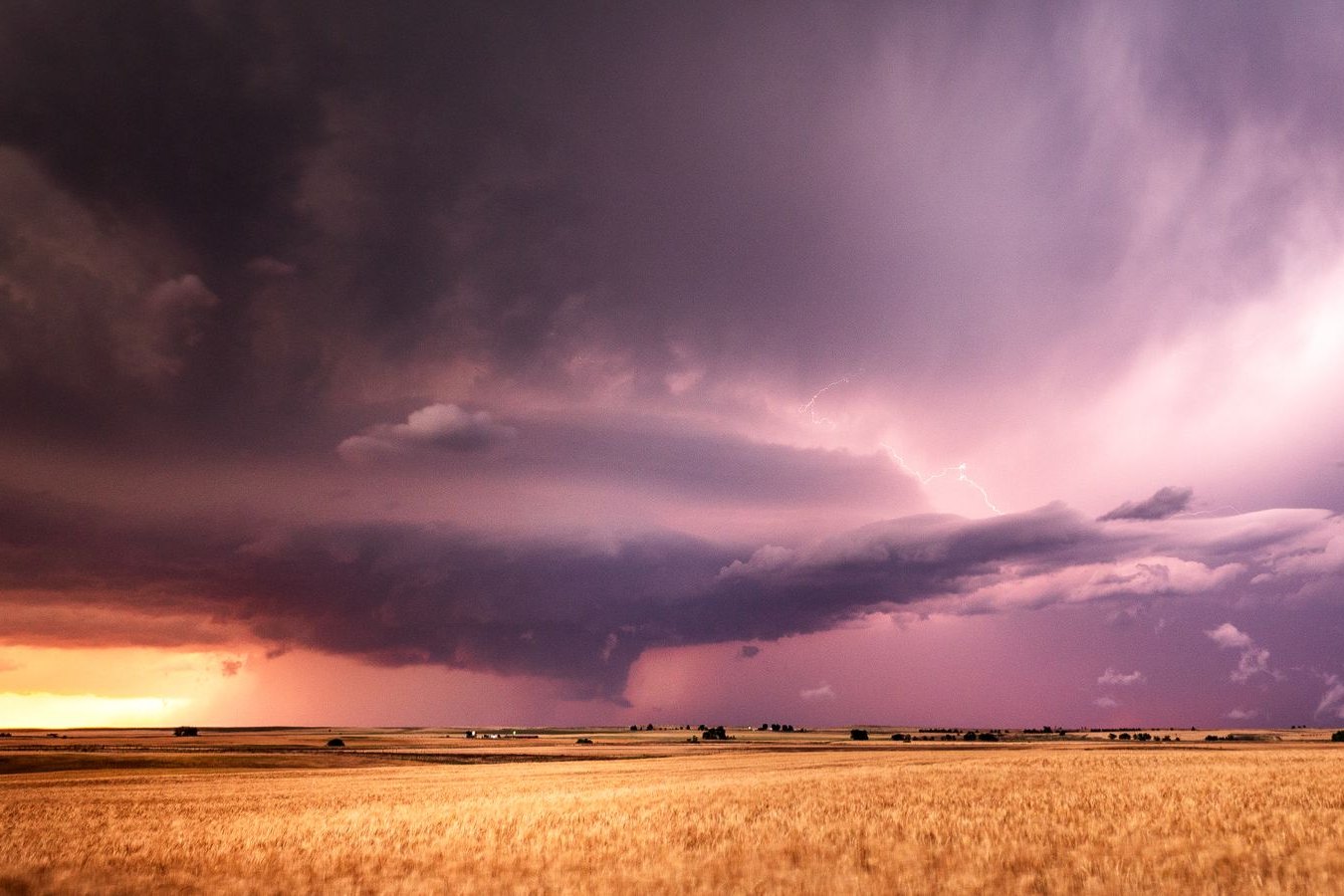
Straight-line wind is the term for any thunderstorm wind that isn’t rotating. That’s the whole definition — it distinguishes the wind from tornadic wind and says nothing about how strong it is. A microburst under four kilometers across, lasting five to ten minutes, can produce maximum winds exceeding 100 mph. Around here, a good share of the wind damage we look at every year never had a funnel over it at all.
The Vocabulary, Briefly
A downdraft is a column of air sinking rapidly toward the ground. When it hits, it spreads outward — think of a faucet hitting the bottom of a sink.
A downburst is the general term for that outward blast. Under about four kilometers across it’s a microburst; larger than that it’s a macroburst, which the National Severe Storms Laboratory notes can produce damage similar to a tornado.
A gust front is the leading edge of rain-cooled air running out ahead of the storm — the wind shift and temperature drop you feel before anything else arrives.
A derecho is the big one: a long-lived wind storm made of clusters of downbursts. To qualify, the damage swath has to run more than 240 miles with gusts of at least 58 mph along most of its length.
How Anyone Tells Afterward
The answer is direction, and it’s readable from the ground.
Tornado winds rotate and converge. Trees and debris fall toward the centerline of the path from both sides, often crossed over each other at odd angles. Downburst winds diverge. Everything falls away from the point of impact, or lies down in one uniform direction along the swath, combed flat.
That’s what a National Weather Service damage survey is doing when a crew walks a neighborhood in Moore or along the Arcadia stretch of Route 66 the morning after — reading direction to work backward to a cause. It’s also why two neighbors can give completely different accounts of the same five minutes and both be describing it honestly.
What It Means for the Paperwork
Here’s the part that surprises people: the distinction matters enormously to meteorologists and much less to the claim.
Most property policies of this type address wind as a peril without grading it by whether it rotated. A tree through a roof in Deer Creek is a tree through a roof. What tends to actually drive how a claim resolves is the age and condition of what was damaged, whether the roof is settled at replacement cost or actual cash value, and — in Oklahoma more than most states — the wind and hail deductible, which is frequently written as a percentage of the dwelling limit rather than a flat dollar amount. We wrote about that mechanic separately, and it’s worth reading before the next round rather than after.
The percentage deductible doesn’t care about rotation either. Neither does the roof-age schedule. Policies vary on all of this considerably, and the policy is the thing that answers it.
The Record Is Newer Than the Weather
Fifteen federal disaster declarations in Oklahoma name straight-line winds in the title. Every single one was declared in 2010 or later, and six of them landed between 2023 and 2025.
The honest reading of that is not that the wind arrived in 2010. Oklahoma has been getting flattened by non-rotating thunderstorm wind since long before anybody wrote it into a declaration title. What changed is the labeling — the damage was previously folded into “severe storms” and “tornadoes” without a separate name. It’s a good reminder that a federal declaration is a government aid threshold, not a measure of what happened to any one house, and certainly not what triggers a claim.
The unflattering part for our side of the counter: because straight-line wind events don’t get named the way tornadoes do, they don’t stick in memory the same way. People remember the date of a tornado. Almost nobody remembers the date of the downburst that took their fence, which means they also don’t remember what their deductible did that year.
If you want someone to read your declarations page with you before the next round of storms rather than after, see how our home coverage works or call (405) 861-8500. You call, we answer.
This article is general information about how coverage typically works, not advice about your specific situation. Policy language — not website descriptions — determines coverage, and your policy is the only thing that says what you have.